Fields of Two Harvests: The Quiet Agrivoltaic Revolution Transforming American Farmland
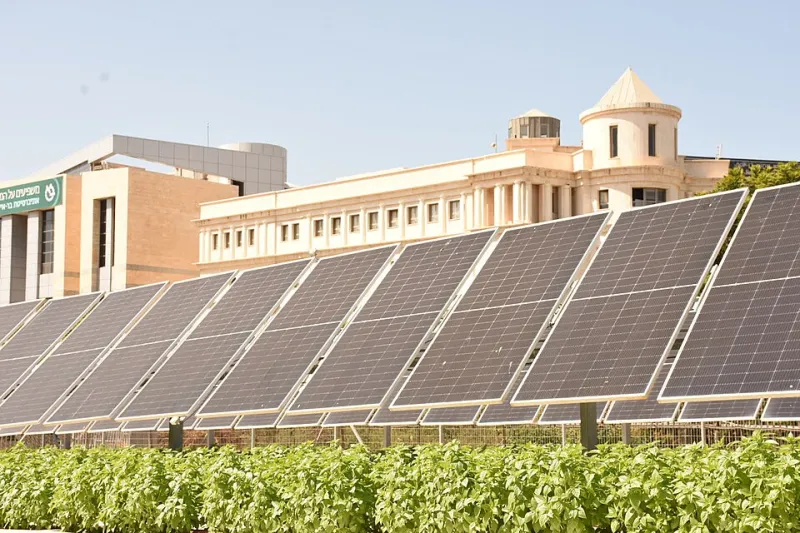
Photo: Kinglir2026, CC BY 4.0, via Wikimedia Commons
On a 240-acre farm in central Illinois, rows of elevated solar panels cast moving shadows over beds of leafy greens and pollinator habitat. The panels tilt to follow the sun. The crops below — shade-tolerant varieties selected through careful agronomic research — grow at yields that, in some cases, match or surpass what the same land produced under full sun exposure. Meanwhile, the farm's owner collects both harvest revenue and electricity lease payments, a financial arrangement that was essentially unavailable to American farmers a decade ago.
This is agrivoltaics in practice: a land-use strategy that treats solar energy production and agricultural activity not as rivals for the same acres, but as mutually reinforcing enterprises on a single parcel. The concept has roots in European research programs dating to the 1980s, but it has arrived in the United States with considerable momentum, driven by the convergence of falling solar costs, federal incentive programs, and a farm economy in which additional revenue streams are frequently the difference between solvency and loss.
The Science Beneath the Panels
The agronomic case for dual-use solar installations is more nuanced than either enthusiasts or skeptics typically acknowledge. Not every crop thrives under partial shade, and not every solar configuration is compatible with the equipment and practices of working farms. The science, however, is increasingly specific about where the approach succeeds.
Research from the University of Massachusetts Amherst, which operates one of the country's most closely monitored agrivoltaic test sites, has documented yield increases for shade-tolerant crops including broccoli, kale, and Swiss chard grown beneath elevated panel arrays. The partial shading reduces heat stress during peak summer temperatures — a benefit that is growing in significance as climate change pushes average temperatures higher across major agricultural regions. Soil moisture retention also improves under panel arrays, reducing irrigation demand in water-stressed areas.
For pollinator-friendly installations — a design approach that seeds the ground beneath and around panels with native wildflowers, clover, and grasses — the ecological benefits extend beyond the farm boundary. A 2022 study published in the journal Environmental Science & Technology found that solar sites managed with pollinator habitat provided measurable benefits to honeybee and native bee populations within a several-mile radius, with potential positive effects on surrounding crop pollination. In an era when commercial beekeepers report annual colony losses averaging 40 percent or more, the conservation value of this habitat is not trivial.
The structural requirements for agricultural compatibility add cost to standard solar installations. Panels must be elevated to allow farm equipment passage, typically requiring taller racking systems. Row spacing must accommodate both solar yield optimization and crop access. These modifications can increase per-megawatt installation costs by 15 to 30 percent compared with conventional ground-mounted solar — a premium that project economics must justify through the combined value of energy production and agricultural output.
Revenue Arithmetic and the Farmer's Calculation
For landowners considering agrivoltaic arrangements, the financial analysis involves several intersecting variables. The most straightforward model involves leasing land to a solar developer while retaining agricultural use rights — a structure that provides predictable annual income without requiring the farmer to manage the energy system. Lease rates for solar development in agricultural areas have risen substantially in recent years, with prime sites in the Midwest and Mid-Atlantic commanding between $800 and $1,500 per acre annually, depending on grid proximity and irradiance levels.
More integrated models, in which farmers own or co-own the solar installation, offer higher long-term returns but require access to capital and comfort with energy system management. Federal incentives available through the Inflation Reduction Act, including the 30 percent Investment Tax Credit for solar installations and bonus credits for projects in designated energy communities, have improved the economics of farmer-owned systems considerably. The USDA's Rural Energy for America Program (REAP) provides additional grant and loan guarantee support specifically for agricultural producers and rural small businesses investing in renewable energy.
Caroline Adeyemi, who operates a diversified vegetable farm in the Shenandoah Valley of Virginia, installed an agrivoltaic system in 2022 with partial REAP grant support. The 180-kilowatt array covers approximately four acres of her 85-acre property, positioned over beds she now plants with shade-adapted crops. Her electricity costs — previously a significant operating expense for her irrigation and cold storage systems — have dropped to near zero, and she sells excess generation back to the grid under a net metering agreement with her utility. "The panels paid for themselves faster than I expected," she said. "And the crops underneath are actually doing fine — better than fine in July and August."
Policy Terrain: Incentives, Barriers, and the Zoning Thicket
Despite promising economics and a growing body of supportive research, agrivoltaic adoption in the United States remains constrained by a fragmented and sometimes contradictory policy environment. Zoning and land-use regulations at the county and municipal level represent perhaps the most immediate barrier. Many jurisdictions classify solar installations as industrial land uses, which can trigger restrictions or outright prohibitions on agricultural land — even when the installation is designed specifically to maintain agricultural productivity.
Several states have moved to address this inconsistency. Illinois enacted legislation in 2021 establishing a formal definition of agrivoltaic systems and directing state agencies to develop supportive permitting frameworks. Minnesota and Massachusetts have incorporated dual-use solar provisions into their community solar and net metering programs. But the majority of states have not yet addressed the regulatory status of agrivoltaic installations with any specificity, leaving project developers and farmers to navigate ambiguity on a jurisdiction-by-jurisdiction basis.
Utility interconnection policies present a related challenge. The process of connecting a solar installation to the grid — already a source of significant delay and cost for standard projects — can be further complicated when agricultural operations create physical or operational constraints on standard interconnection approaches. Advocates have called on the Federal Energy Regulatory Commission and state public utility commissions to develop streamlined pathways for small and mid-scale agrivoltaic projects, which rarely pose the grid management challenges associated with large utility-scale installations.
Farm bill policy also shapes the landscape in ways that are not always aligned with dual-use development. Certain USDA conservation program payments have historically been conditioned on maintaining land in specific agricultural uses, creating uncertainty about whether agrivoltaic installations might affect program eligibility. The 2023 Farm Bill reauthorization process offered an opportunity to clarify these provisions, and agricultural and clean energy advocacy organizations submitted joint comments urging explicit recognition of agrivoltaic systems as compatible with conservation program participation.
Case Studies in Convergence
Beyond individual farms, some of the most instructive examples of agrivoltaic development involve institutional and cooperative arrangements that aggregate multiple landowners or integrate energy production with processing and distribution infrastructure.
In Colorado, a solar developer partnered with a sheep ranching cooperative to develop a 50-megawatt installation across several adjacent properties. The sheep graze beneath the panel arrays, providing vegetation management services that reduce the developer's maintenance costs while generating additional income for the ranchers. The arrangement has become a model for similar projects across the Mountain West, where sheep grazing beneath solar arrays — sometimes called "solar grazing" — is increasingly recognized as a practical and mutually beneficial land management strategy.
In Michigan, a fruit farming operation integrated a rooftop solar system on its cold storage facility with a ground-mounted array over a portion of its apple orchard. Early data suggest that the partial shading is reducing sunburn damage on fruit — a quality problem that has worsened with rising summer temperatures — while the energy system offsets the substantial electricity demand of the cold storage operation.
These examples illustrate a core principle that agrivoltaic advocates consistently emphasize: the approach is not a single technology or a standardized template, but a design philosophy that must be adapted to the specific agronomic, geographic, and economic context of each operation. That flexibility is both the concept's greatest strength and the source of its implementation complexity.
For American farmers facing persistent cost pressures, climate volatility, and uncertain commodity markets, the prospect of generating two income streams from the same land is compelling. For a nation committed to expanding renewable energy deployment while maintaining agricultural productivity, agrivoltaics represents a land-use solution that deserves far more policy attention and public investment than it has thus far received.