After the Mine Closes: How Fossil Fuel Communities Are Building New Economies Around Clean Energy
In Welch, West Virginia, the McDowell County seat, the population has contracted by more than 80 percent since its mid-twentieth-century peak. The coal seams that once made this corner of Appalachia economically vital have been largely exhausted or rendered uneconomical by market forces that no tariff or political promise can fully reverse. The story is familiar across dozens of American counties: shuttered mines, abandoned storefronts, outmigration of working-age residents, and a tax base too depleted to fund adequate schools or public services.
Yet in Welch, as in communities from eastern Kentucky to rural Wyoming, something is beginning to stir. Not the return of coal — that chapter is closing regardless of political rhetoric — but the tentative, sometimes fragile emergence of a different economic identity rooted in the very energy transition that displaced the old one. The question is not whether the fossil fuel economy will be succeeded by something new. The question is whether communities will have agency in shaping what comes next, or whether they will once again be bystanders to decisions made elsewhere.
Appalachia's Solar Pivot: Kentucky's Letcher County
Letcher County, Kentucky, sits in the heart of Central Appalachian coal country. At its employment peak, coal mining sustained thousands of local jobs and generated the tax revenues that built the county's schools and roads. Today, fewer than a few hundred mining jobs remain. The county's poverty rate is among the highest in the nation.
In 2022, Letcher County became one of the first communities in the region to break ground on a solar manufacturing facility through a partnership between local economic development authorities, a regional community development financial institution, and a North Carolina-based clean energy developer. The facility, which produces mounting hardware for utility-scale solar installations, employs approximately 120 workers at wages above the county median — not a transformation on the scale of the coal economy at its height, but a meaningful and durable foundation.
What made the project viable was a combination of federal incentives — particularly the IRA's domestic content provisions, which created strong market incentives to manufacture solar components in the United States — and the deliberate cultivation of local political support. County officials who had spent decades advocating for coal were persuaded by the straightforward economics: the jobs were real, the wages were competitive, and the industry was not going to disappear. The ideological framing mattered less than the paycheck.
"People in this county don't care whether the electricity comes from coal or solar," one county commissioner told a regional publication. "They care whether their kids can find a job here without leaving."
The Rust Belt's Battery Bet: Lordstown, Ohio
Lordstown, Ohio, became a symbol of industrial decline when General Motors shuttered its assembly plant in 2019, eliminating thousands of jobs in a community whose identity was inseparable from automobile manufacturing. The closure became a national political flashpoint. What followed, however, illustrates both the promise and the complexity of clean energy reinvention.
Ultium Cells, a joint venture between GM and LG Energy Solution, subsequently chose the Lordstown site for a major electric vehicle battery manufacturing facility. The plant, which began production in 2023, represents billions of dollars in investment and thousands of direct and indirect jobs. It is among the largest battery manufacturing facilities in North America. Crucially, it employs many of the same workers — and draws on the same industrial skill sets — that the GM assembly plant once required.
Lordstown's experience carries important lessons. The transition was not painless or seamless; the gap between the plant's closure and the battery facility's opening spanned years during which workers and families bore real economic hardship. Union negotiations over wages and working conditions at the new facility were contentious, and labor advocates continue to press for compensation structures that reflect the facility's strategic importance to the national energy transition. The community's story is not a triumphant linear narrative but a complicated, ongoing negotiation between economic necessity and worker dignity.
Still, the fundamental trajectory is instructive: existing industrial infrastructure, workforce expertise, and supply chain relationships can be redirected toward clean energy manufacturing far more efficiently than building from scratch in greenfield locations. The Lordstown model suggests that the geography of America's industrial past may, in important respects, be well-suited to the geography of its clean energy future.
Wyoming's Wind Dilemma: Opportunity and Resistance
Wyoming presents perhaps the most politically complex case study in energy community transition. The state is among the nation's largest coal producers and exporters, and its political culture has historically been deeply resistant to federal climate policy. It is also endowed with extraordinary wind resources — some of the best in the continental United States — and sits in geographic proximity to western load centers hungry for clean electricity.
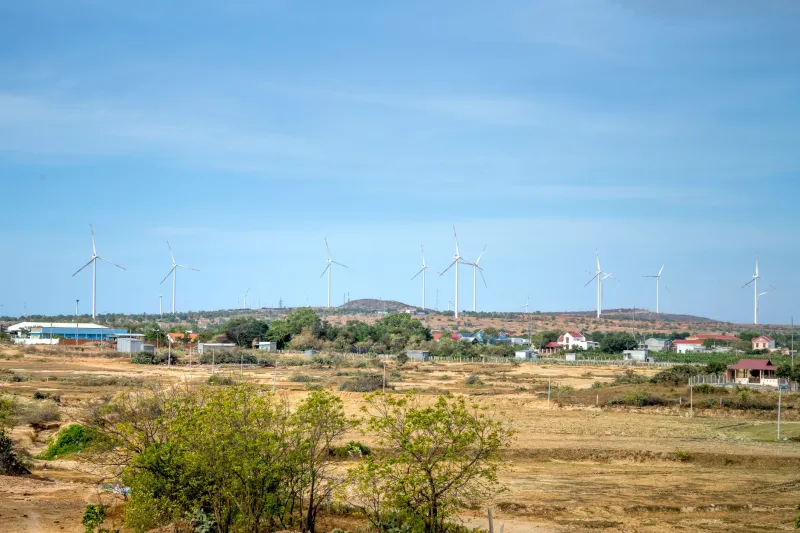
The Chokecherry and Sierra Madre Wind Energy Project in Carbon County, Wyoming, when fully built, will be one of the largest wind facilities in the world, capable of generating up to 3,000 megawatts of electricity transmitted to California and other western markets via new high-voltage direct current transmission lines. The project has faced years of permitting delays, legal challenges, and political opposition, but construction is now underway.
For Carbon County — whose name derives from the coal deposits that once defined its economy — the wind project represents a significant inflection point. Property tax revenues from the wind facility are projected to substantially exceed those generated by remaining coal operations within the decade. Local ranchers who lease land for turbine easements receive reliable annual income that supplements agricultural revenues. The county is investing wind tax receipts in infrastructure improvements and economic diversification initiatives.
Yet the transition is not without friction. Some longtime residents perceive the shift from fossil fuels to renewables as an externally imposed cultural disruption rather than a locally driven choice. Workforce retraining programs have struggled to reach older workers whose skills are highly specific to mining operations. And the transmission infrastructure required to export Wyoming's wind power to distant markets remains a significant and unresolved bottleneck — a reminder that community-level reinvention is always constrained by regional and national infrastructure decisions.
What the Successful Cases Share
Across these and other communities pursuing clean energy reinvention — from Pueblo, Colorado's growing solar manufacturing sector to the former coal port of Baltimore now handling offshore wind components — several common factors distinguish more successful transitions from those that have struggled.
Deliberate workforce investment. Communities that have made sustained, adequately funded commitments to retraining programs — particularly those developed in partnership with community colleges, labor unions, and specific employers — have achieved significantly better employment outcomes than those relying on market forces alone. The Appalachian Regional Commission's POWER Initiative and the Department of Energy's Energy Communities programs have been important catalysts, though advocates argue that funding levels remain insufficient relative to the scale of need.
Local ownership and revenue retention. Projects structured to retain a meaningful share of economic value within the community — through local equity stakes, community benefit agreements, or municipal ownership models — generate broader and more durable economic benefits than purely extractive investment relationships. Communities that negotiated robust community benefit agreements with renewable developers have seen more of the promised economic gains materialize.
Long-term political commitment. Energy transitions operate on timescales that exceed typical electoral cycles. Communities whose leadership has maintained consistent, bipartisan support for transition strategies across multiple administrations have navigated the process more successfully than those where clean energy became a partisan battleground.
Honest acknowledgment of what is lost. Perhaps counterintuitively, communities that have openly acknowledged the genuine losses associated with the decline of legacy industries — rather than papering over them with premature optimism — have built more resilient social coalitions around transition strategies. Grief and economic reinvention are not mutually exclusive.
The Road Ahead
The communities profiled here are not outliers or anomalies. They are early iterations of a transformation that will, over the coming decades, touch virtually every corner of the American economy. The United States cannot complete its energy transition without confronting the human geography of the fossil fuel economy — the workers, families, and communities whose lives are intertwined with industries that must fundamentally change.
Clean energy can be an engine of economic renewal for these places. The evidence is accumulating. But that potential will not be realized automatically or equitably without deliberate policy, sustained investment, and genuine respect for the agency of communities that have already absorbed more than their share of economic disruption.
The mine may be closed. The reinvention is just beginning.