The Hard-to-Abate Economy: Breaking the Barriers That Keep America's Heaviest Industries Locked in Carbon
When Americans picture the clean energy transition, they tend to envision solar arrays spreading across sun-drenched fields, wind turbines rising above the Great Plains, and electric vehicles humming along interstate highways. These are real and necessary developments. But they address only a portion of the emissions problem — and arguably not the most intractable portion.
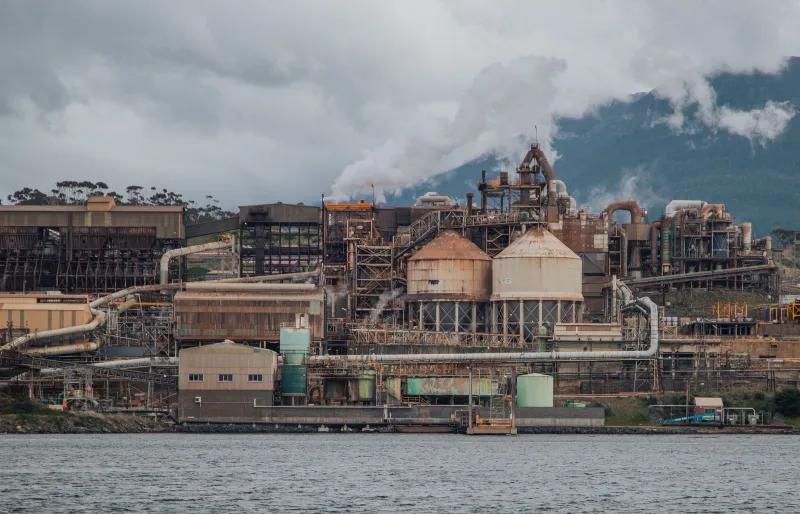
Behind the visible economy of consumption and transportation lies a vast industrial substrate: the steel mills of Indiana and Pennsylvania, the cement plants of Texas and California, the chlorine refineries of Louisiana, the aluminum smelters of the Pacific Northwest. These facilities are the foundational layer of American material civilization. They are also, collectively, among the most carbon-intensive operations on earth — and they have proven stubbornly resistant to the decarbonization momentum that has reshaped the power sector over the past decade.
Understanding why requires moving beyond slogans and into the specific physics, economics, and policy architecture that govern industrial energy use.
Why Electricity Alone Cannot Solve the Industrial Emissions Problem
The most straightforward pathway to decarbonizing the power sector involves substituting fossil fuel generation with renewable electricity. For heavy industry, an analogous substitution is far more complicated, for reasons that are fundamentally thermodynamic.
Cement production, for example, requires heating limestone to approximately 1,450 degrees Celsius in a rotary kiln. Roughly 40 percent of the sector's carbon emissions arise not from the fuel used to generate this heat, but from the chemical decomposition of the limestone itself — a process called calcination that releases CO₂ regardless of the energy source. No amount of renewable electricity can eliminate process emissions of this kind without a fundamental redesign of the production chemistry.
Steelmaking presents a parallel challenge. The dominant production method — basic oxygen furnace steelmaking using blast furnaces — relies on metallurgical coke derived from coal, which serves not merely as a fuel but as a chemical reducing agent that strips oxygen from iron ore. Replacing this process with electric arc furnaces fed by renewable power is technically feasible, and is already practiced at scale for recycled steel. But producing virgin steel from iron ore without coal requires either green hydrogen as an alternative reducing agent or direct electrolysis of iron ore — technologies that exist at demonstration scale but have not yet been proven economically competitive at full industrial volume.
Chemical manufacturing encompasses hundreds of distinct processes, many of which require high-temperature heat, specific chemical feedstocks derived from fossil fuels, or both. Aluminum smelting, while electrically intensive and therefore theoretically more amenable to decarbonization through grid cleaning, requires such enormous quantities of power that the economics are highly sensitive to electricity prices — creating a structural dependency on low-cost fossil fuel generation in many regions.
The Economic Architecture of Lock-In
Technical barriers alone do not explain the persistence of industrial carbon emissions. Economic incentive structures play an equally important role, and they consistently favor the status quo.
Heavy industrial facilities represent capital investments of hundreds of millions to billions of dollars, with operational lifespans measured in decades. A blast furnace commissioned in 2010 will not reach the end of its economic life until the 2040s or beyond. The owners of that asset face a stark choice: write down the investment and transition to a cleaner process, or continue operating and amortizing the existing capital. In the absence of a carbon price that makes continued operation genuinely costly, the financial logic almost always favors the latter.
This dynamic is compounded by the global competitive environment in which American manufacturers operate. Steel producers in the United States compete against counterparts in China, India, and elsewhere whose governments impose no comparable environmental costs on production. Unilateral decarbonization by American firms, absent border carbon adjustments or equivalent international commitments, risks shifting production — and associated emissions — overseas rather than eliminating them. This "carbon leakage" concern is not hypothetical; it has influenced industrial policy debates in Washington for years and has consistently weakened the political will to impose meaningful carbon pricing on domestic manufacturers.
The financing landscape for industrial decarbonization projects presents further obstacles. Green hydrogen electrolyzers, direct reduced iron facilities, and carbon capture installations are capital-intensive, technologically novel, and commercially unproven at scale. Private lenders and equity investors, accustomed to the relatively predictable risk profiles of conventional industrial assets, have been reluctant to provide capital at the terms that would make these projects financially viable. The result is a persistent gap between the technologies that are theoretically available and those that are actually being deployed.
Case Studies in Attempted Transition
A small but instructive set of American industrial firms have moved beyond rhetorical commitment to active decarbonization investment, and their experiences illuminate both what is possible and where the system continues to fail.
Nucor Corporation, the largest steel producer in the United States, has built its business model around electric arc furnace technology using recycled scrap — a process that is dramatically less carbon-intensive than blast furnace steelmaking. Nucor has announced intentions to further reduce its emissions intensity through increased use of renewable electricity and direct reduced iron produced with lower-carbon inputs. Its experience demonstrates that electrification-based decarbonization of secondary steelmaking is commercially viable. It also illustrates the limits of that approach: scrap availability constrains how much of domestic steel demand can be met through recycling alone.
In the cement sector, Heidelberg Materials — which operates extensively in North America through its Lehigh Hanson subsidiary — is pursuing carbon capture and storage at its Redding, California plant, with ambitions to extend the technology to additional facilities. The project has received support from the Department of Energy's Office of Clean Energy Demonstrations. Whether it can be replicated at the scale required to meaningfully decarbonize the U.S. cement industry remains an open question, contingent on the build-out of CO₂ transport and storage infrastructure that does not yet exist at the necessary scale.
The chemicals sector has seen scattered commitments to green hydrogen as a feedstock replacement for grey hydrogen in ammonia and methanol production, but capital deployment has lagged pledges significantly. High electrolyzer costs and the absence of durable green hydrogen pricing signals have kept most projects in the feasibility study phase.
The Policy Gap and How to Close It
The gap between industrial decarbonization ambition and industrial decarbonization reality is, at its core, a policy failure — one that can and must be corrected.
The Inflation Reduction Act of 2022 took meaningful steps in this direction, extending investment tax credits to industrial decarbonization technologies including green hydrogen production, carbon capture, and advanced manufacturing processes. The law's provisions for hydrogen production tax credits, in particular, represent the most significant federal commitment to industrial decarbonization in American history. But the IRA's implementation has been uneven, its eligibility criteria have generated substantial uncertainty, and its incentive levels are not calibrated to the full cost gap between clean and conventional industrial production in many sectors.
A robust industrial decarbonization policy framework would incorporate several additional elements. A border carbon adjustment — analogous to the European Union's Carbon Border Adjustment Mechanism, which entered its transitional phase in 2023 — would level the competitive playing field for U.S. manufacturers who invest in cleaner processes, while eliminating the carbon leakage incentive that currently discourages unilateral action. Federal procurement standards that preference low-embodied-carbon materials in public infrastructure projects would create demand signals sufficient to justify private investment in cleaner production methods. And targeted loan guarantee programs through the Department of Energy's Loan Programs Office could provide the patient capital that private markets have been unwilling to supply.
State-level industrial decarbonization standards, modeled on California's efforts to establish buy-clean procurement requirements, offer a complementary avenue for driving change in sectors where federal action remains politically constrained.
The Stakes Are Too High for Incrementalism
America's energy-intensive industries will not decarbonize themselves on the current trajectory. The barriers are too high, the incumbent economics too favorable, and the policy signals too weak to produce the pace of change that climate science demands.
But the stakes of inaction are equally clear. A clean energy transition that succeeds in eliminating emissions from the power sector while leaving steel, cement, chemicals, and aluminum untouched will fall far short of the reductions required to meet U.S. climate commitments. The hard-to-abate economy is not a footnote to the decarbonization challenge — it is a central chapter, and it is one that the Sustainable Energy Coalition is committed to keeping squarely in view.